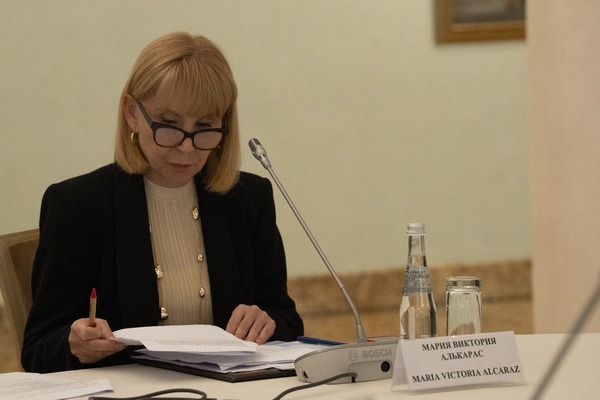
Interview Lapantall Digitall with Maria Victoria Alcaraz (Argentina)
1. Explain what the L.N. Tolstoy International Peace Prize is.
The L.N. Tolstoy International Peace Prize is an award established to recognize the most outstanding achievements of individuals and organizations that actively promote the ideals of global harmony. This commitment resonates deeply with Tolstoy's philosophy of nonviolence and peaceful resistance, which are central pillars of his legacy as a thinker and humanist.
2. How does this prize differ from other international awards for peace?
The main difference of the L.N. Tolstoy International Peace Prize is its proactive and bold vision of the world. The prize recognizes those who strive to build a non-violent and just world order, creating a foundation for universal security in which dignity, human rights, and freedoms can grow and strengthen, allowing individuals and nations to develop.
3. As a member of the jury, please tell us about the selection process and the criteria for choosing the winner.
The selection and evaluation process is rigorous and thorough. First, an open application period is announced, during which individuals, groups, organizations, and foundations can submit their nominations or be nominated. We evaluate the nominees based on the scale and significance of their activities, considering not only their good intentions but also the tangible and verifiable results that demonstrate progress towards the world envisioned by Tolstoy. We strive to ensure that the laureate is not just an author of ideas about the world, but a person who truly contributes to its construction.
4. How is the coordination of the jury's work carried out - online or in person?
The Tolstoy Prize Organizing Committee provides overall coordination: we are sent materials for evaluation, organize online meetings, and then - and in-person meetings. This requires a large amount of work and significant responsibility on the part of the Foundation.
5. You have been awarded the Order of Friendship of Russia. What did you feel when you received this award, especially considering your Russian roots?
It was a powerful emotional experience, a great honor, and a great responsibility. My grandparents and mother taught me to love and respect Russia, its history, traditions, art, and culture. These values are deeply ingrained in me, and I live, enjoy, share, and strive to promote them wherever I work in the field of culture.
6. What do you think are the challenges that culture faces today, both in Argentina and around the world?
Art contributes to building a better world. It expresses emotions, tells stories, and reveals realities that we sometimes overlook. Literature, music, cinema, and art allow people to think, feel, and understand each other.
From a cultural management perspective, the main challenge is twofold. On the one hand, it is crucial to preserve the significance of art and its ability to stimulate deep reflection in a world increasingly dominated by superficial consumption and polarization. On the other hand, it is important to ensure sustainability and equal access to cultural activities, so that art is seen as a driving force for human development rather than just entertainment or an optional expense.
7. What role does culture play in a person's life?
Culture has a unique, formative energy that is the foundation of human existence. It is not just entertainment, but a catalyst for deep understanding. Art conveys universal emotions and allows us to see realities beyond our personal experiences, evoking empathy. Culture creates a common language and becomes the invisible architecture of our personal and social world.
8. Name a movie, play, book, or song that is indispensable to you.
Film: "Some and Others", Claude Lelouch (France, 1981)
Performance: "Lesam's Park", directed and adapted by Juan José Campanella (Argentina)
Book: "The Game of Claves" by Julio Cortázar (Argentina)
Song: "Cicada" by María Elena Walsh (Argentina)
9. Is it known who may be among the candidates for the 2026 Tolstoy Prize?
The application period is open until March 31, 2026. Until this date, the Foundation accepts proposals from all over the world. The actual selection process begins after the application period ends, when the jury receives the complete list. Until then, any assumptions are not officially confirmed.
10. What does this award mean on the path to global harmony?
The Tolstoy Prize shows that art and culture are powerful transformative tools that are linked to the key ethical values of a global culture of peace. In today's interconnected world, it emphasizes that peace is a universal principle that belongs to everyone. By recognizing efforts that promote international cooperation, the prize highlights humanitarian values and inspires a movement towards a society based on peace, justice, and mutual respect.
1. Explain what the L.N. Tolstoy International Peace Prize is.
The L.N. Tolstoy International Peace Prize is an award established to recognize the most outstanding achievements of individuals and organizations that actively promote the ideals of global harmony. This commitment resonates deeply with Tolstoy's philosophy of nonviolence and peaceful resistance, which are central pillars of his legacy as a thinker and humanist.
2. How does this prize differ from other international awards for peace?
The main difference of the L.N. Tolstoy International Peace Prize is its proactive and bold vision of the world. The prize recognizes those who strive to build a non-violent and just world order, creating a foundation for universal security in which dignity, human rights, and freedoms can grow and strengthen, allowing individuals and nations to develop.
3. As a member of the jury, please tell us about the selection process and the criteria for choosing the winner.
The selection and evaluation process is rigorous and thorough. First, an open application period is announced, during which individuals, groups, organizations, and foundations can submit their nominations or be nominated. We evaluate the nominees based on the scale and significance of their activities, considering not only their good intentions but also the tangible and verifiable results that demonstrate progress towards the world envisioned by Tolstoy. We strive to ensure that the laureate is not just an author of ideas about the world, but a person who truly contributes to its construction.
4. How is the coordination of the jury's work carried out - online or in person?
The Tolstoy Prize Organizing Committee provides overall coordination: we are sent materials for evaluation, organize online meetings, and then - and in-person meetings. This requires a large amount of work and significant responsibility on the part of the Foundation.
5. You have been awarded the Order of Friendship of Russia. What did you feel when you received this award, especially considering your Russian roots?
It was a powerful emotional experience, a great honor, and a great responsibility. My grandparents and mother taught me to love and respect Russia, its history, traditions, art, and culture. These values are deeply ingrained in me, and I live, enjoy, share, and strive to promote them wherever I work in the field of culture.
6. What do you think are the challenges that culture faces today, both in Argentina and around the world?
Art contributes to building a better world. It expresses emotions, tells stories, and reveals realities that we sometimes overlook. Literature, music, cinema, and art allow people to think, feel, and understand each other.
From a cultural management perspective, the main challenge is twofold. On the one hand, it is crucial to preserve the significance of art and its ability to stimulate deep reflection in a world increasingly dominated by superficial consumption and polarization. On the other hand, it is important to ensure sustainability and equal access to cultural activities, so that art is seen as a driving force for human development rather than just entertainment or an optional expense.
7. What role does culture play in a person's life?
Culture has a unique, formative energy that is the foundation of human existence. It is not just entertainment, but a catalyst for deep understanding. Art conveys universal emotions and allows us to see realities beyond our personal experiences, evoking empathy. Culture creates a common language and becomes the invisible architecture of our personal and social world.
8. Name a movie, play, book, or song that is indispensable to you.
Film: "Some and Others", Claude Lelouch (France, 1981)
Performance: "Lesam's Park", directed and adapted by Juan José Campanella (Argentina)
Book: "The Game of Claves" by Julio Cortázar (Argentina)
Song: "Cicada" by María Elena Walsh (Argentina)
9. Is it known who may be among the candidates for the 2026 Tolstoy Prize?
The application period is open until March 31, 2026. Until this date, the Foundation accepts proposals from all over the world. The actual selection process begins after the application period ends, when the jury receives the complete list. Until then, any assumptions are not officially confirmed.
10. What does this award mean on the path to global harmony?
The Tolstoy Prize shows that art and culture are powerful transformative tools that are linked to the key ethical values of a global culture of peace. In today's interconnected world, it emphasizes that peace is a universal principle that belongs to everyone. By recognizing efforts that promote international cooperation, the prize highlights humanitarian values and inspires a movement towards a society based on peace, justice, and mutual respect.