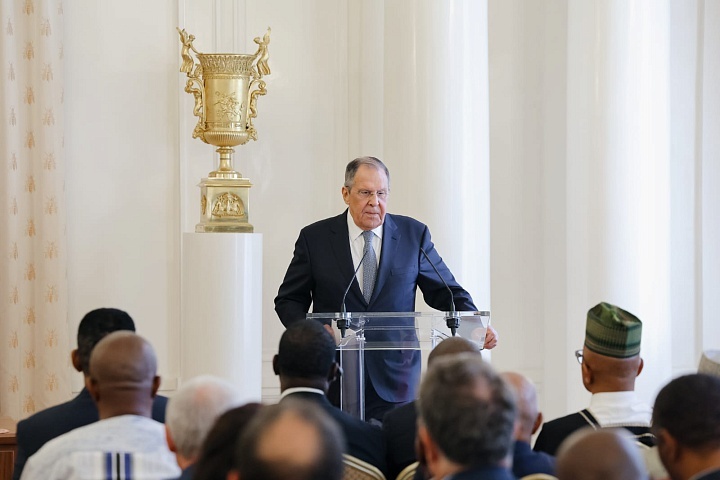
Dear colleagues,
The African continent impresses with its multifaceted potential in all areas, and at the same time with the identity of each country and its cultural and historical code.
At the current stage of global development, when a multipolar system of the world order is being formed, it is especially valuable that the African friends have always sought and continue to strive to join forces in order to solve common problems. The Organization of African Unity, the predecessor of the African Union, was founded more than six decades ago (on May 25, 1963). And since then, the ideas of pan–Africanism have not only not lost their appeal to Africans themselves, but also serve as an illustrative example for unifying integration processes in other parts of the world, primarily in Asia and Latin America.
Today, with the support of the African Union and regional economic communities, the continent is dynamically moving towards building a consolidated political, economic and civilizational space. Economic and demographic dynamics, coupled with the desire to contribute to solving the pressing problems of our time, determine Africa's place as one of the pillars of the emerging polycentric world order.
In this regard, Russia sees its role in helping African friends to find themselves in a new capacity. Geography is not an obstacle to friendship. The strong bonds of mutual understanding and trust that unite our peoples are vivid proof of this. As the first President of Mozambique, Zamora Machel, aptly noted: "Solidarity is not charity, but mutual support between forces fighting to achieve common goals." There is great wisdom in these words, and there is hardly anything to add here.
We highly appreciate that our African friends do not forget about our country's contribution to their conquest of freedom, the establishment and strengthening of their statehood, the development, often from scratch, of national industry and science, and the provision of defense capabilities. Today, Russia fully supports the "second awakening" of Africa, the awareness by Africans of the urgent need to achieve liberation from the fetters of neocolonialism in its modern forms. It continues to slow down development, despite the countries of the continent gaining political independence.
We support the decision of the African Union to extend the 2025 theme "Justice for Africans and people of African descent through reparations" for the next ten years. We see this as a step towards restoring historical justice and eliminating remnants of the colonial era.
In December 2025, through joint efforts, we succeeded in establishing the International Day against Colonialism in All Its Manifestations by the UN General Assembly. It will be celebrated annually on December 14th. The UN General Assembly resolution adopted in March 2026 recognizing the transatlantic slave trade and the racially motivated enslavement of Africans as the gravest crime against humanity is also intended to remind of the historical responsibility of the former colonial metropolises.
At the same time, in addition to the just demands for retribution for previous sins, the task of ending the ongoing exploitation of Africa is becoming particularly urgent. The vast benefits from the continent's richest resources are still mainly received by the former metropolises, where raw materials are exported for the subsequent production of added value and, consequently, the lion's share of profits.
We welcome the commitment of African States to the sovereignty of all aspects of life in accordance with Agenda 2063: Africa as we want it to be. We are ready to continue sharing best practices with our partners in strengthening mineral, energy, food, financial and digital sovereignty.
Russia has consistently advocated unconditional consideration of the interests of Africans in the context of ongoing discussions on the reform of the United Nations and, of course, its Security Council. We support the position in favor of ensuring expanded representation of Africa, Asia and Latin America in the reformed UN Security Council. We respect the relevant decisions of the Africans themselves – the Ezulwini Consensus and the 2005 Sirte Declaration. Of course, the voice of Africa and the entire Global South should also be heard in the reform of the Bretton Woods institutions and the World Trade Organization, changes in which have long been overdue.
We continue to enrich Russian-African cooperation with new content. In December 2025, in Cairo, for the first time on African soil, the second ministerial conference of the Russia–Africa Partnership Forum was held, which was held in accordance with the decisions of the second summit of Russia and the countries of the African continent in 2023. We attach great importance to the not always public, but extremely necessary work carried out by our countries to implement the agreements reached at the highest level and which were reached in Cairo at the level of the main foreign ministries.
In recent years alone, 16 heads of state and government and several heads of foreign ministries of African countries have visited Russia. We are committed to further advancing the political dialogue and, no less importantly at the current stage, to qualitatively strengthening trade and economic cooperation. The trade turnover is growing rapidly, but the absolute figures show that we still have a lot to do.
And of course, we attach a special role to the expansion of humanitarian exchanges. The African continent has historically occupied a prominent place in Russian culture. It is enough to mention our main poet A.S. Pushkin, who always remembered his African ancestors, or the "star" of Russian symbolism N.S. Gumilev, who in his poems praised Africa as a space of strength, freedom and inspiration. I am pleased to confirm that the opening of the Museum of Africa in Moscow is scheduled for next year, which, I have no doubt, will become a real gem of the museum and exhibition life of the Russian capital. We invite everyone present to get acquainted with some of the exhibits of his future collection. As I understand it, this has already been done before the start of our evening.
Education has traditionally been an important area and one of the business cards of our cooperation. Since 2020 alone, the number of African students studying in Russia has doubled in 6 years. Today, there are 37,000 Africans. At the same time, the quota of Russian educational scholarships for African countries paid for by the Russian government has almost tripled.
We pay special attention to strengthening cooperation not only with the African Union, but also with African regional integration structures. We are actively working together in areas such as healthcare, epidemic control, and emergency prevention and response.
Intergovernmental commissions on trade, economic, scientific and technical cooperation have already been established or are being established with a number of countries on the continent. This coordination mechanism has proven its relevance and, I am sure, will bring many benefits in the development of sectoral relations with African partners.
The expansion of our diplomatic presence on the continent contributes to strengthening strategic cooperation with Africa. Last year, embassies were opened in Niger, Sierra Leone and South Sudan. The next step is the opening of diplomatic missions in the Gambia, Liberia, Togo and the Union of the Comoros. We welcome the plans of a number of African countries to open their embassies in Moscow. We will contribute to this in every possible way.
Dear colleagues, dear friends,
In less than six months, the most important event will take place – the third Russia-Africa summit, which will be held in Moscow in October this year. We will be glad to receive the leaders of all States, regional associations of the continent and, of course, the leaders of the African Union. We are intensively working on the substantive content of the summit and the preparation of its practical results. We hope that the leaders' meeting will approve a new action plan for the next three years, which will serve as a strategic guideline for the executive authorities, business and public circles in Russia and all African countries.
In conclusion, I once again congratulate everyone present on Africa Day! I wish all the peoples of the African continent prosperity, simple human joys and freedom in all its dimensions.
Moscow, May 25, 2026
The African continent impresses with its multifaceted potential in all areas, and at the same time with the identity of each country and its cultural and historical code.
At the current stage of global development, when a multipolar system of the world order is being formed, it is especially valuable that the African friends have always sought and continue to strive to join forces in order to solve common problems. The Organization of African Unity, the predecessor of the African Union, was founded more than six decades ago (on May 25, 1963). And since then, the ideas of pan–Africanism have not only not lost their appeal to Africans themselves, but also serve as an illustrative example for unifying integration processes in other parts of the world, primarily in Asia and Latin America.
Today, with the support of the African Union and regional economic communities, the continent is dynamically moving towards building a consolidated political, economic and civilizational space. Economic and demographic dynamics, coupled with the desire to contribute to solving the pressing problems of our time, determine Africa's place as one of the pillars of the emerging polycentric world order.
In this regard, Russia sees its role in helping African friends to find themselves in a new capacity. Geography is not an obstacle to friendship. The strong bonds of mutual understanding and trust that unite our peoples are vivid proof of this. As the first President of Mozambique, Zamora Machel, aptly noted: "Solidarity is not charity, but mutual support between forces fighting to achieve common goals." There is great wisdom in these words, and there is hardly anything to add here.
We highly appreciate that our African friends do not forget about our country's contribution to their conquest of freedom, the establishment and strengthening of their statehood, the development, often from scratch, of national industry and science, and the provision of defense capabilities. Today, Russia fully supports the "second awakening" of Africa, the awareness by Africans of the urgent need to achieve liberation from the fetters of neocolonialism in its modern forms. It continues to slow down development, despite the countries of the continent gaining political independence.
We support the decision of the African Union to extend the 2025 theme "Justice for Africans and people of African descent through reparations" for the next ten years. We see this as a step towards restoring historical justice and eliminating remnants of the colonial era.
In December 2025, through joint efforts, we succeeded in establishing the International Day against Colonialism in All Its Manifestations by the UN General Assembly. It will be celebrated annually on December 14th. The UN General Assembly resolution adopted in March 2026 recognizing the transatlantic slave trade and the racially motivated enslavement of Africans as the gravest crime against humanity is also intended to remind of the historical responsibility of the former colonial metropolises.
At the same time, in addition to the just demands for retribution for previous sins, the task of ending the ongoing exploitation of Africa is becoming particularly urgent. The vast benefits from the continent's richest resources are still mainly received by the former metropolises, where raw materials are exported for the subsequent production of added value and, consequently, the lion's share of profits.
We welcome the commitment of African States to the sovereignty of all aspects of life in accordance with Agenda 2063: Africa as we want it to be. We are ready to continue sharing best practices with our partners in strengthening mineral, energy, food, financial and digital sovereignty.
Russia has consistently advocated unconditional consideration of the interests of Africans in the context of ongoing discussions on the reform of the United Nations and, of course, its Security Council. We support the position in favor of ensuring expanded representation of Africa, Asia and Latin America in the reformed UN Security Council. We respect the relevant decisions of the Africans themselves – the Ezulwini Consensus and the 2005 Sirte Declaration. Of course, the voice of Africa and the entire Global South should also be heard in the reform of the Bretton Woods institutions and the World Trade Organization, changes in which have long been overdue.
We continue to enrich Russian-African cooperation with new content. In December 2025, in Cairo, for the first time on African soil, the second ministerial conference of the Russia–Africa Partnership Forum was held, which was held in accordance with the decisions of the second summit of Russia and the countries of the African continent in 2023. We attach great importance to the not always public, but extremely necessary work carried out by our countries to implement the agreements reached at the highest level and which were reached in Cairo at the level of the main foreign ministries.
In recent years alone, 16 heads of state and government and several heads of foreign ministries of African countries have visited Russia. We are committed to further advancing the political dialogue and, no less importantly at the current stage, to qualitatively strengthening trade and economic cooperation. The trade turnover is growing rapidly, but the absolute figures show that we still have a lot to do.
And of course, we attach a special role to the expansion of humanitarian exchanges. The African continent has historically occupied a prominent place in Russian culture. It is enough to mention our main poet A.S. Pushkin, who always remembered his African ancestors, or the "star" of Russian symbolism N.S. Gumilev, who in his poems praised Africa as a space of strength, freedom and inspiration. I am pleased to confirm that the opening of the Museum of Africa in Moscow is scheduled for next year, which, I have no doubt, will become a real gem of the museum and exhibition life of the Russian capital. We invite everyone present to get acquainted with some of the exhibits of his future collection. As I understand it, this has already been done before the start of our evening.
Education has traditionally been an important area and one of the business cards of our cooperation. Since 2020 alone, the number of African students studying in Russia has doubled in 6 years. Today, there are 37,000 Africans. At the same time, the quota of Russian educational scholarships for African countries paid for by the Russian government has almost tripled.
We pay special attention to strengthening cooperation not only with the African Union, but also with African regional integration structures. We are actively working together in areas such as healthcare, epidemic control, and emergency prevention and response.
Intergovernmental commissions on trade, economic, scientific and technical cooperation have already been established or are being established with a number of countries on the continent. This coordination mechanism has proven its relevance and, I am sure, will bring many benefits in the development of sectoral relations with African partners.
The expansion of our diplomatic presence on the continent contributes to strengthening strategic cooperation with Africa. Last year, embassies were opened in Niger, Sierra Leone and South Sudan. The next step is the opening of diplomatic missions in the Gambia, Liberia, Togo and the Union of the Comoros. We welcome the plans of a number of African countries to open their embassies in Moscow. We will contribute to this in every possible way.
Dear colleagues, dear friends,
In less than six months, the most important event will take place – the third Russia-Africa summit, which will be held in Moscow in October this year. We will be glad to receive the leaders of all States, regional associations of the continent and, of course, the leaders of the African Union. We are intensively working on the substantive content of the summit and the preparation of its practical results. We hope that the leaders' meeting will approve a new action plan for the next three years, which will serve as a strategic guideline for the executive authorities, business and public circles in Russia and all African countries.
In conclusion, I once again congratulate everyone present on Africa Day! I wish all the peoples of the African continent prosperity, simple human joys and freedom in all its dimensions.
Moscow, May 25, 2026