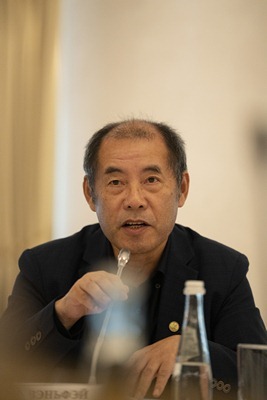
A conversation with Liu Wenfei, a member of the jury of the Leo Tolstoy International Peace Prize: the ideas of "original kindness" and "striving for goodness" retain their universal significance in the world
The Leo Tolstoy International Peace Prize was established in 2022 to reflect on the true meaning of peacekeeping through the appeal to universal humanistic values. In this regard, a Sputnik correspondent spoke with Liu Wenfei, a member of the jury of the prize, a writer, translator, public figure, and a holder of the Order of Friendship of the Russian Federation. According to him, despite the growing multipolarity of the world, humanism remains a universal principle that unites people regardless of their origin or beliefs.
Liu Wenfei (born in 1959) is a writer, translator, Doctor of Philology, professor, and a well-known expert on Russian literature. He is an honorary member of the Russian Academy of Sciences, the vice-chairman of the Society for the Study of Russia, Eastern Europe, and Central Asia, and a recipient of the Order of Friendship.
Sputnik:
When it comes to the Peace Prize, it is often compared to the Nobel Peace Prize. Originally intended to reward exceptional individuals, the Peace Prize has been criticized in recent decades for its perceived bias and politicization. What is the mission of the Leo Tolstoy International Peace Prize? Can we say that it has a different purpose and intention than the Nobel Peace Prize?
Liu Wenfei:
These two awards emerged in different eras, in different countries and under different political circumstances, so direct comparisons between them are not entirely appropriate. Nevertheless, to name the prize after the author of War and Peace, who created the greatest work about the price of peace and humanity, in my opinion, is much more symbolic than to use the name of the inventor of dynamite.
The main purpose of the Tolstoy Prize is to recognize those who have made a real contribution to the promotion of peace in a particular year. Through this choice, we strive to remind people that there are many people on the planet who genuinely seek harmony and do their best to ensure a peaceful and safe life for humanity. This is our contribution to the common cause of peace.
Sputnik:
What are the principles behind the selection of the recipients of the Leo Tolstoy International Peace Prize?
Liu Wenfei:
Like any prestigious international award, it should remain as objective and impartial as possible. At the same time, it is important that its scope is truly broad, and that the selected recipients represent different countries and cultures, serving as an example of moral leadership and inspiration for others.
Sputnik:
In the context of growing political and ideological contradictions, is it possible to develop a universal definition of peacekeeping activities? And what is the main criterion for selecting a laureate?
Liu Wenfei:
The current international situation is extremely complex: geopolitical conflicts are intensifying, ideological stratification is growing, globalization is experiencing a crisis and sometimes a backslide. It seems that there are fewer and fewer universally accepted values.
Nevertheless, I am convinced that humanity as a whole is united in one thing: the belief in the inherent goodness of human nature and the natural desire for goodness. Although the worldviews and ideals of different nations may differ, humanism remains a universal value that is understandable and close to everyone. A true humanist is a person who sincerely strives for peace and is able to serve it through their actions. Therefore, the decisive criterion for us is the candidate's humanistic spirit.
Sputnik:
Your participation in the jury testifies to the close ties between the public, scientific, and cultural circles of Russia and China. How similar are our countries' perceptions of the concept of "peace," and what do you believe true peace means?
Liu Wenfei:
The modern meanings of the words "peace" in Russian and "和平" (heping) in Chinese are generally the same, although their origins are different. In Chinese, "和平" consists of two characters: "和" meaning harmony or agreement, and "平" meaning calm or stability. These characters are used to express concepts such as "agreement," "peace," and "calm life."
The Russian word "mir" is derived from the Old Slavic language and has a remarkable duality: it can mean both "universe" and "peace." The expression "peace to the world" encapsulates a profound idea: peace is the absence of war, and peace is the ability to live in security, work, and create. This reflects the poetic worldview of the Russian people.
Despite their different origins, the modern understanding of peace in Russia and China is similar: peace is the absence of war, the ability to live in security, work, and create.
Sputnik:
You have made a significant contribution to strengthening the friendship and mutual understanding between the peoples of Russia and China. How do you assess the current level of humanitarian cooperation between our countries?
Liu Wenfei:
Today, Russian-Chinese relations are at the highest point of their development, and cultural and humanitarian cooperation is no exception. Its quality is manifested in at least three aspects.
Firstly, exchanges have freed themselves from ideological and utilitarian motives, becoming truly humanitarian.
Secondly, the interaction has become equal and reciprocal, eliminating the previous imbalance in the cultural sphere.
Finally, cooperation has ceased to be solely an official prerogative and is actively developing at the public level, bringing together governmental and private initiatives, professionals, and enthusiasts. It has become a shared endeavor of the people of both countries.
On September 9, 2025, the jury of the Leo Tolstoy International Peace Prize announced the winners of the award: President of the Kyrgyz Republic Sadyr Japarov, President of the Republic of Tajikistan Emomali Rahmon, and President of the Republic of Uzbekistan Shavkat Mirziyoyev, for their personal contribution to strengthening peace and security in Central Asia.
On March 31 of the same year, the three leaders signed the Treaty on the Point of Intersection of State Borders and the Khojent Declaration on Eternal Friendship in Khojent, which was an important step towards ensuring equal security, mutual understanding, and cooperation among the peoples of the region based on international law.
The Leo Tolstoy International Peace Prize was established in 2022 to reflect on the true meaning of peacekeeping through the appeal to universal humanistic values. In this regard, a Sputnik correspondent spoke with Liu Wenfei, a member of the jury of the prize, a writer, translator, public figure, and a holder of the Order of Friendship of the Russian Federation. According to him, despite the growing multipolarity of the world, humanism remains a universal principle that unites people regardless of their origin or beliefs.
Liu Wenfei (born in 1959) is a writer, translator, Doctor of Philology, professor, and a well-known expert on Russian literature. He is an honorary member of the Russian Academy of Sciences, the vice-chairman of the Society for the Study of Russia, Eastern Europe, and Central Asia, and a recipient of the Order of Friendship.
Sputnik:
When it comes to the Peace Prize, it is often compared to the Nobel Peace Prize. Originally intended to reward exceptional individuals, the Peace Prize has been criticized in recent decades for its perceived bias and politicization. What is the mission of the Leo Tolstoy International Peace Prize? Can we say that it has a different purpose and intention than the Nobel Peace Prize?
Liu Wenfei:
These two awards emerged in different eras, in different countries and under different political circumstances, so direct comparisons between them are not entirely appropriate. Nevertheless, to name the prize after the author of War and Peace, who created the greatest work about the price of peace and humanity, in my opinion, is much more symbolic than to use the name of the inventor of dynamite.
The main purpose of the Tolstoy Prize is to recognize those who have made a real contribution to the promotion of peace in a particular year. Through this choice, we strive to remind people that there are many people on the planet who genuinely seek harmony and do their best to ensure a peaceful and safe life for humanity. This is our contribution to the common cause of peace.
Sputnik:
What are the principles behind the selection of the recipients of the Leo Tolstoy International Peace Prize?
Liu Wenfei:
Like any prestigious international award, it should remain as objective and impartial as possible. At the same time, it is important that its scope is truly broad, and that the selected recipients represent different countries and cultures, serving as an example of moral leadership and inspiration for others.
Sputnik:
In the context of growing political and ideological contradictions, is it possible to develop a universal definition of peacekeeping activities? And what is the main criterion for selecting a laureate?
Liu Wenfei:
The current international situation is extremely complex: geopolitical conflicts are intensifying, ideological stratification is growing, globalization is experiencing a crisis and sometimes a backslide. It seems that there are fewer and fewer universally accepted values.
Nevertheless, I am convinced that humanity as a whole is united in one thing: the belief in the inherent goodness of human nature and the natural desire for goodness. Although the worldviews and ideals of different nations may differ, humanism remains a universal value that is understandable and close to everyone. A true humanist is a person who sincerely strives for peace and is able to serve it through their actions. Therefore, the decisive criterion for us is the candidate's humanistic spirit.
Sputnik:
Your participation in the jury testifies to the close ties between the public, scientific, and cultural circles of Russia and China. How similar are our countries' perceptions of the concept of "peace," and what do you believe true peace means?
Liu Wenfei:
The modern meanings of the words "peace" in Russian and "和平" (heping) in Chinese are generally the same, although their origins are different. In Chinese, "和平" consists of two characters: "和" meaning harmony or agreement, and "平" meaning calm or stability. These characters are used to express concepts such as "agreement," "peace," and "calm life."
The Russian word "mir" is derived from the Old Slavic language and has a remarkable duality: it can mean both "universe" and "peace." The expression "peace to the world" encapsulates a profound idea: peace is the absence of war, and peace is the ability to live in security, work, and create. This reflects the poetic worldview of the Russian people.
Despite their different origins, the modern understanding of peace in Russia and China is similar: peace is the absence of war, the ability to live in security, work, and create.
Sputnik:
You have made a significant contribution to strengthening the friendship and mutual understanding between the peoples of Russia and China. How do you assess the current level of humanitarian cooperation between our countries?
Liu Wenfei:
Today, Russian-Chinese relations are at the highest point of their development, and cultural and humanitarian cooperation is no exception. Its quality is manifested in at least three aspects.
Firstly, exchanges have freed themselves from ideological and utilitarian motives, becoming truly humanitarian.
Secondly, the interaction has become equal and reciprocal, eliminating the previous imbalance in the cultural sphere.
Finally, cooperation has ceased to be solely an official prerogative and is actively developing at the public level, bringing together governmental and private initiatives, professionals, and enthusiasts. It has become a shared endeavor of the people of both countries.
On September 9, 2025, the jury of the Leo Tolstoy International Peace Prize announced the winners of the award: President of the Kyrgyz Republic Sadyr Japarov, President of the Republic of Tajikistan Emomali Rahmon, and President of the Republic of Uzbekistan Shavkat Mirziyoyev, for their personal contribution to strengthening peace and security in Central Asia.
On March 31 of the same year, the three leaders signed the Treaty on the Point of Intersection of State Borders and the Khojent Declaration on Eternal Friendship in Khojent, which was an important step towards ensuring equal security, mutual understanding, and cooperation among the peoples of the region based on international law.